

At TheRemodelers.org we don't sell anything. Instead we provide information that helps our community make decisions regarding home improvement services and projects. Click below for recommended licensed professionals that provide free no obligation quotes.
Bathroom Remodeling: The Complete Homeowner's Guide
Bathroom Remodel Projects: Costs, Ideas & Expert Guide
TheRemodelers brings together licensed bathroom contractors and industry professionals to help homeowners understand bathroom remodeling — what it costs at every level, how long it realistically takes, which decisions drive cost up or down, and how to choose a contractor who delivers a bathroom that looks good and functions correctly for decades.
Bathroom Remodel Cost & Planning: What Homeowners Should Actually Expect
A bathroom remodel is one of the most common home improvement projects and one of the easiest to misprice if you walk into it without understanding what drives the final number. Two bathrooms of the same size in homes on the same street can produce quotes $20,000 apart, and if you do not know what accounts for that difference, you cannot evaluate which quote is fair and which is not.
This guide covers everything you need to know before the first contractor walks through your door. What a bathroom remodel costs at every level, where the money actually goes, what drives the price, how long the work realistically takes, the decisions worth spending on and the ones that do not return their cost, and what to look for in a contractor. The goal is to give you enough information to make a confident decision before anyone swings a hammer.
What a Bathroom Remodel Costs in 2026
Bathroom remodel costs are not one number. The range is wide because the scope varies enormously — a cosmetic refresh and a full gut renovation with layout changes are fundamentally different projects. Understanding which tier your project falls into is the first step toward a realistic budget.
Cosmetic Refresh: $2,500 to $7,000
A refresh keeps the existing layout and plumbing exactly where it is. You are updating surfaces and fixtures, not moving anything. This tier typically includes a new vanity and countertop, new faucet and hardware, a new mirror and light fixtures, paint on walls and ceiling, regrouting or refinishing existing tile, and a new toilet or toilet seat. No plumbing or electrical changes, no permit required in most jurisdictions.
This is the right approach when the bathroom is functional but dated and the layout works for how you use the space. The refresh tier is also where sweat equity makes the biggest difference in total cost — painting, replacing hardware, and swapping a mirror are all within reach of a handy homeowner. If you can do the cosmetic work yourself and hire a plumber only for fixture connections, a refresh can come in under $4,000 with quality materials.
Mid-Range Remodel: $12,000 to $25,000
This is where most homeowner projects land. The mid-range remodel replaces everything in the bathroom — flooring, vanity, countertop, shower or tub, toilet, fixtures, lighting, and ventilation — without moving plumbing or making structural changes. At this level you are choosing mid-range materials: porcelain tile instead of natural stone, a stock vanity instead of custom cabinetry, a standard shower door instead of frameless glass.
Labor is the largest line item, typically 40 to 60 percent of the total. A mid-range remodel in a standard 5x8 foot bathroom with a tub-shower combination is the most common project configuration and the one most cost estimates are based on. It assumes the bathroom is in a home built within the last 30 to 40 years where the plumbing and electrical are in acceptable condition. If the home is older or the bathroom has known issues behind the walls, budget toward the upper end of this range.
High-End or Full Gut Renovation: $30,000 to $60,000+
A full gut remodel changes the layout, moves plumbing and electrical, and uses premium materials throughout. This tier typically includes moving the toilet, sink, or shower to a different wall, converting a tub to a walk-in shower with custom tile and frameless glass, custom cabinetry and natural stone countertops, heated flooring, high-end fixtures and designer lighting, and possibly expanding the bathroom footprint into adjacent space. Adding an entirely new bathroom where none currently exists is its own distinct project — the guide to bathroom addition cost covers what that involves separately from a standard remodel.
At this level, design fees, engineering if structural work is involved, and longer construction timelines all add to the total. The design and planning phase alone can take four to eight weeks before demolition begins, and material lead times for custom elements extend the overall project to three to six months from decision to completion. The guide to high-end bathroom remodels shows what this level of work looks like in real projects with before and after examples.
Where the Money Actually Goes
Understanding the cost breakdown helps you compare quotes from different contractors on equal terms and decide where to spend and where to save.
Labor accounts for 40 to 65 percent of the total budget. Tile setters, plumbers, and electricians each bill at $50 to $150 per hour depending on your market, and a full remodel involves all three trades. A mid-range bathroom remodel might involve 120 to 200 hours of combined labor across trades.
After labor, the largest material costs in order are tile and flooring — $2 to $30 per square foot for material alone, with installation adding $50 to $120 per hour. Porcelain tile at $3 to $8 per square foot is the most common choice for its combination of durability, water resistance, and reasonable cost. Natural stone at $10 to $30 per square foot is the premium option. Large-format tile installs faster than mosaic but costs more per square foot for the material. The guide to bathroom tile types compares these and other material options by price point and durability in more detail.
The vanity and countertop are the next largest material expense — $300 to $600 for builder-grade, $1,200 to $2,500 for solid wood with quartz, and $4,000 to $8,000 for custom cabinetry with stone. A double-sink vanity costs more than a single but adds functionality that buyers notice in a master bathroom. The guide to where to buy a bathroom vanity covers options at each price point, and the guide to bathroom countertop materials compares quartz, granite, marble, and solid surface specifically for vanity tops.
The shower or tub is typically the single most expensive element — $300 to $1,500 for a prefab fiberglass or acrylic surround, $1,500 to $4,000 for a tiled surround with a prefab pan, and $5,000 to $12,000+ for a fully custom tile shower with frameless glass door and built-in niches. The shower door alone — frameless glass versus framed — differs by $500 to $1,500. The tub-to-shower conversion guide covers what is involved in the most common bathroom layout change.
Fixtures — faucets, showerheads, towel bars, and lighting — range from $200 to $2,000+ depending on finish and brand. Brushed nickel, chrome, and matte black are the most popular finishes in 2026. A pressure-balanced shower valve is a code requirement in most areas and adds cost over a basic valve, but it is not optional — it prevents sudden temperature changes when someone flushes a toilet elsewhere in the house. The guide to bathroom plumbing fixture cost breaks this down further by fixture type.
Permits run $200 to $800 in most jurisdictions for any project involving plumbing or electrical changes. In some cities permit costs are higher and plan review adds several weeks to the front end of the project. Ventilation — a new exhaust fan properly vented to the exterior — costs $200 to $600 installed and is code-required in any bathroom with a shower or tub.
What Drives Cost Up or Down
Two bathrooms of the same size can produce quotes thousands of dollars apart. Here is what moves the number.
Moving plumbing is the single biggest cost driver. Keeping the toilet, sink, and shower in their existing locations avoids the most expensive part of a remodel. Moving a toilet across the room involves cutting into the floor, relocating the drain line, potentially working around floor joists, and re-routing the vent stack — all of which adds labor time and cost. A toilet moved 4 feet can add $1,000 to $3,000 to the project.
Tile choices change the labor cost significantly. Large-format tile — 12x24 inches or larger — goes up faster than small mosaic. Complex patterns like herringbone or diagonal layouts add installation hours on top of material cost. Natural stone tile requires sealing and more careful handling than porcelain. The difference between basic 4x4 ceramic wall tile and large-format porcelain with decorative accent strips can double the tile labor cost.
The shower is usually the most expensive single element. A prefab fiberglass surround installed in a day costs a fraction of a custom tile shower that takes a week. Adding a built-in bench, multiple showerheads, body sprays, or a steam generator each add thousands to the shower line item. The guide to walk-in tub installation covers a specific shower and tub configuration that adds accessibility without sacrificing function, and the overview of bathtub overlays explains a lower-cost alternative to full tub replacement.
Your location matters significantly. Bathroom remodel labor rates in major coastal metros — New York, San Francisco, Los Angeles, Boston, Seattle — run 30 to 50 percent higher than in the Midwest and South. Material costs are more consistent nationally, though shipping to remote locations can add cost.
The age of the home affects cost more than most homeowners expect. Older homes are more likely to have surprises behind the walls — rotted subfloor from years of slow toilet or tub leaks, outdated galvanized plumbing that needs replacing to meet current code, cast iron drain lines that have corroded internally, wiring that is not up to current GFCI standards, or in homes built before the 1980s, asbestos in flooring or drywall that requires licensed abatement. A good contractor budgets contingency for these discoveries. A contractor who does not mention them during the estimate is not being honest about what the project might actually cost.
Cost by Bathroom Type and Size
The type of bathroom being remodeled changes the cost equation because different bathrooms serve different functions and justify different levels of investment.
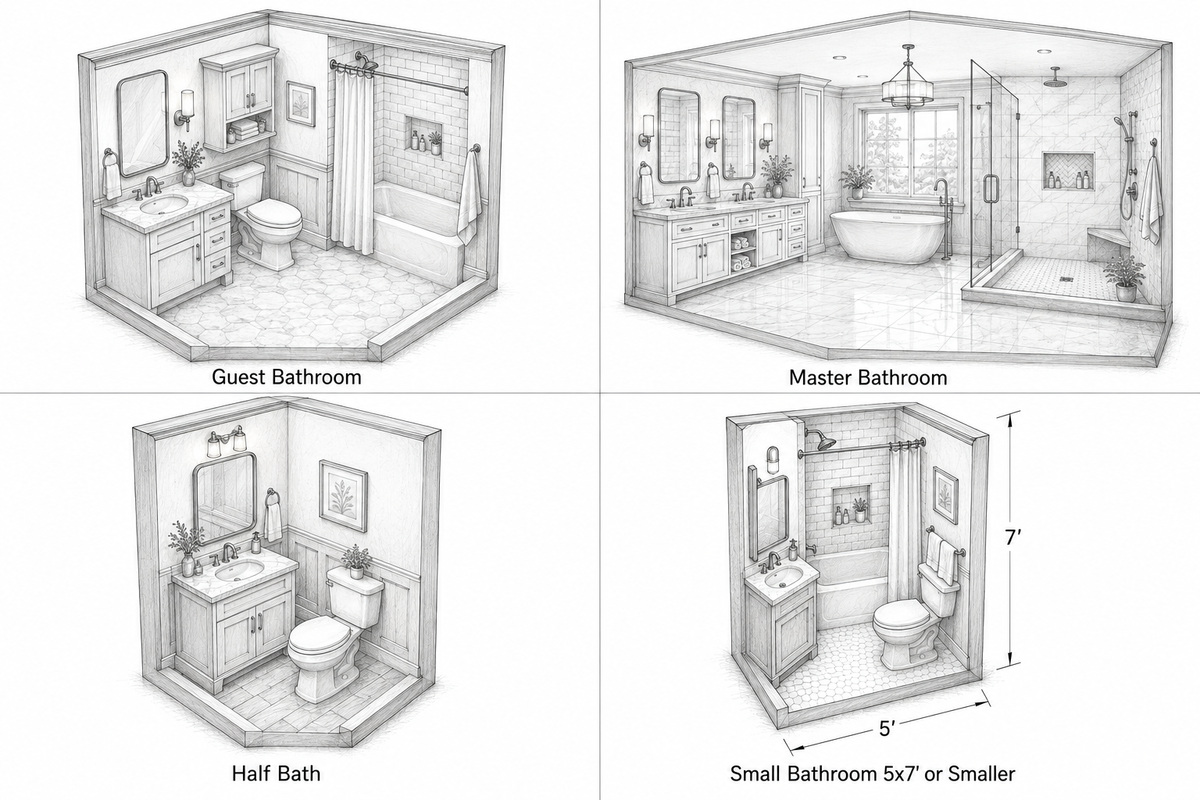
A hall bathroom or guest bathroom — typically 5x8 feet with a tub-shower combination, single vanity, and toilet — is the most common remodel configuration and the one most cost ranges are based on. A mid-range remodel of this bathroom runs $12,000 to $22,000. These bathrooms benefit most from clean, durable materials and timeless finishes rather than trend-driven upgrades.
A master bathroom or primary bathroom — typically larger at 8x10 to 12x15 feet, often with a double vanity, separate shower and tub, and a private toilet compartment — costs more because of the larger square footage and the higher fixture count. A mid-range remodel of a master bathroom runs $20,000 to $40,000. A high-end master bathroom remodel with layout changes, custom cabinetry, and premium finishes routinely runs $40,000 to $80,000 or more. The guide to master bathroom remodel cost breaks down that spending phase by phase, including a real contractor's budget and regional cost variance.
A powder room or half bath — toilet and sink only, no shower or tub — is the least expensive bathroom to remodel because there is no wet area requiring waterproofing or tile work. A mid-range powder room remodel runs $5,000 to $10,000. A powder room is also the bathroom where a small splurge on a distinctive vanity, mirror, or light fixture has the most visual impact per dollar because there is less square footage to outfit. Homeowners considering adding a shower or tub to an existing half bath instead can find that cost breakdown in the guide to half-bath-to-full-bath conversion cost.
A small bathroom — 5x7 feet or smaller — presents space constraints that drive different decisions. The guide to small bathroom remodel cost covers how to maximize function in a limited footprint without overspending, and 5 tricks to make small bathrooms look bigger covers design strategies that create visual space without moving walls.
Regional Cost Differences
Where you live is one of the largest variables in what you will pay for a bathroom remodel of the same scope and quality.
Major coastal metros run 30 to 50 percent higher on labor than the national average. A mid-range bathroom remodel that costs $18,000 in Ohio can run $28,000 in San Francisco for the same scope, same materials, and same quality of work. The difference is almost entirely labor and local business overhead — insurance, workers' compensation, and the cost of doing business in high-cost regions.
The Midwest and South — Ohio, Indiana, Missouri, Tennessee, Alabama, Texas outside Austin — typically see the lowest installed costs, with labor rates 20 to 30 percent below the national average. Mid-tier cities — Denver, Charlotte, Nashville, Austin, Portland, Minneapolis — fall between the coastal and heartland ranges, with mid-range remodels typically running $15,000 to $25,000.
Material costs are more consistent nationally — a porcelain tile that costs $4 per square foot in Dallas costs roughly the same in Seattle — but shipping to remote locations, islands, or mountain communities with limited access adds meaningful freight cost. In Hawaii, Alaska, and remote mountain towns, expect material costs to run 15 to 30 percent higher than mainland urban prices.
How Long a Bathroom Remodel Actually Takes
Most homeowners underestimate how long a bathroom remodel takes because they compare it to television renovation shows where a bathroom is finished in a weekend. A bathroom remodel involves multiple trades working in sequence — demolition, rough plumbing and electrical, drywall, tile, finishing — and each phase has minimum time requirements that cannot be compressed without compromising quality.
A cosmetic refresh takes 1 to 2 weeks. A mid-range remodel of a standard 5x8 bathroom without moving plumbing takes 3 to 5 weeks. A full gut renovation with layout changes takes 6 to 10 weeks or longer depending on scope and permit approval timelines. The detailed bathroom remodel timeline guide breaks down what happens each week and what can extend the schedule.
Tile mortar and grout need curing time. Waterproofing membranes need drying time. Paint needs drying time between coats. These are physical requirements that cannot be shortened by working faster or adding more people. Understanding those phases before the project starts prevents frustration and helps you plan around the disruption of having a bathroom out of service.
The single most effective thing you can do to keep the timeline on track is to choose every material and finish before demolition begins. Every decision made mid-project resets part of the schedule. Walk through every selection — tile, grout color, vanity, countertop, faucet, showerhead, shower door style, mirror, lighting, paint color, hardware finish — with your contractor before the first wall comes down, and confirm everything is in stock or has a confirmed delivery date.
Return on Investment: What a Bathroom Remodel Adds to Home Value
A mid-range bathroom remodel recovers approximately 60 to 70 percent of its cost in increased home value at resale. A $20,000 bathroom remodel adds roughly $12,000 to $14,000 to the home's value on average. The return is higher when the bathroom being remodeled is the weakest room in the home — updating a dated, damaged, or dysfunctional bathroom returns more than remodeling one that is already functional and clean.
The highest-return improvements are, in order: fixing visible damage or dated surfaces that would make a buyer nervous, replacing a failing shower or tub that would come up on a home inspection, improving ventilation to prevent moisture damage, updating lighting to make the room feel larger and cleaner, and installing quality fixtures in timeless finishes.
The lowest return comes from ultra-premium materials — custom cabinetry, imported natural stone, designer lighting — installed in a home where the overall value does not support them. A $5,000 custom vanity in a $250,000 home does not return its cost at resale. Match the remodel level to the home's value for the best financial return. If you are remodeling for yourself and plan to stay 10 or more years, the ROI calculation shifts — spend where you will notice and appreciate it every day.
Design Decisions That Matter
The decisions made during the planning phase determine whether the finished bathroom functions well for how you actually use it. The guide to bathroom remodel project planning covers the planning process from initial concept through contractor selection.
Ventilation is the least exciting bathroom decision and one of the most important. A bathroom with a shower or tub must have an exhaust fan vented to the exterior — not into the attic, not recirculating through a filter, not relying on a window being opened. Moisture that stays in the bathroom promotes mold in grout, peels paint, and eventually rots drywall and framing. A properly sized fan that runs for 20 to 30 minutes after a shower removes the moisture that causes most bathroom failures.
Code requires a minimum CFM based on bathroom square footage. A timer switch that keeps the fan running after you leave is a $30 upgrade that prevents the most common ventilation failure — the fan being turned off as soon as the user leaves the room. The guide to bathroom ventilation and mold prevention covers fan sizing, duct routing, and humidity sensors in more detail.
For homes prioritizing accessibility alongside these design decisions, the guide to making bathrooms safer covers how grab bars, curbless showers, and comfort-height fixtures fit into a design-forward remodel rather than reading as an institutional afterthought.
Lighting matters more than most homeowners expect because bathrooms are used for tasks — shaving, applying makeup, checking an outfit — that require good light without shadows. A single ceiling fixture creates shadows on the face. A combination of overhead light, task lighting at the mirror mounted at eye level on both sides rather than above, and a separate light in the shower creates layered lighting that makes the room more functional. The guide to the top bathroom design mistakes covers lighting errors and other common planning failures that are expensive to fix after tile is up.
Storage decisions made during planning prevent a beautiful bathroom from becoming cluttered. A vanity with drawers rather than doors provides more usable storage. A recessed medicine cabinet built into the wall between studs adds storage without taking floor space. A shower niche — a recessed shelf built into the shower wall for shampoo and soap — eliminates the need for a hanging caddy and looks cleaner. The guide to bathroom vanity trends covers current options in vanity style and function.
Tub-to-Shower Conversion: The Most Common Layout Change
Converting a tub-shower combination to a walk-in shower is the most common bathroom layout change and one of the highest-satisfaction remodels for homeowners who rarely use the tub. It improves accessibility — stepping over a tub wall becomes harder with age — and creates a more open, modern look. The guide to walk-in shower cost and installation breaks down that pricing further by size, tile choice, and door type.
The conversion involves removing the existing tub, relocating the drain from the tub position to the center of the new shower floor, installing a new shower pan or building a tiled shower floor with the correct slope to the drain, waterproofing the entire shower area, tiling the walls and floor, and installing a shower door. The tub-to-shower conversion can cost $5,000 to $15,000 depending on the tile choices, door style, and whether plumbing must be significantly relocated. The complete guide to tub-to-shower conversion covers the process, cost, and planning considerations in detail.
If you are converting the only tub in the home to a shower, consider the resale implication. Families with young children and some buyers specifically want at least one bathtub. If the home has a second bathroom with a tub, converting the master tub to a shower has no resale downside in most markets. If it is the only tub, weigh the daily benefit against the potential resale impact.
For homeowners who want a tub but cannot manage the step-over height of a standard tub, walk-in tubs offer a solution. The guide to walk-in tub installation and the overview of best walk-in tubs cover the options, and the guide to walk-in tub cost covers what that category typically runs and what drives the price. Tub liners — an acrylic liner installed over the existing tub — are a lower-cost alternative to full tub replacement covered in the guide to bathtub liner pros, cons, and costs.
How to Choose a Bathroom Contractor
The contractor you choose matters more than the tile you pick. A well-executed renovation with mid-range materials looks better and lasts longer than a poorly executed one with premium materials. Here is what to look for.
Ask for a license and proof of insurance before anything else. Bathroom remodeling involves plumbing and electrical work inside your walls — unlicensed work creates liability for you if something goes wrong and must be disclosed when you sell. A licensed contractor carries liability insurance and workers' compensation. Ask to see the certificates with your own eyes.
Ask whether the contractor uses employees or subcontractors for each trade. It is normal for a general contractor to subcontract plumbing, electrical, and tile work to licensed specialists. What matters is that the GC has established relationships with the same subcontractors across multiple jobs, not whoever is available that week. Ask how long they have worked with each sub.
Ask about their waterproofing method. This is the single most important technical question in a bathroom remodel. A contractor who cannot explain their waterproofing system — which membrane they use, how they handle the transition from the shower pan to the walls, how corners and niches are sealed — is not someone you want building your shower. A shower leak shows up years after the job is done and costs more to fix than the original installation. The 10 bathroom renovation tips from a contractor covers what experienced contractors know that homeowners should ask about.
Ask about permits and whether they are included in the quote. Any remodel involving plumbing or electrical work requires a permit. A contractor who suggests skipping permits is creating a liability for you. The inspections that come with permits are your protection — an independent inspector verifies that the plumbing, electrical, and waterproofing meet current code.
Get at least three itemized quotes. An itemized quote breaks out demo, plumbing, electrical, tile, fixtures, vanity, countertop, shower, permits, and cleanup as separate line items. A single-number quote tells you nothing about what is included or excluded. Compare scope before comparing price. A lower quote that does not include permits, uses thinner grout lines, specifies a lower grade of tile, or excludes the exhaust fan is not cheaper — it is incomplete.
Ask for references from jobs completed in the past year and follow up on them. Ask those references specifically about whether the contractor communicated when surprises were discovered behind the walls, whether the timeline held, and whether the punch list at the end was handled promptly. These questions tell you more than "were you happy with the work."
Final Thoughts
A bathroom remodel is worth doing when the budget is realistic, the scope matches the home, and the contractor is vetted properly. The homeowners who get the best results are the ones who understand what drives cost before the first contractor walks through the door, who make every material decision before demolition begins, who budget contingency for what might be behind the walls, and who hire a licensed contractor who permits the job and can explain their waterproofing system in detail.
The cost ranges, timeline expectations, and contractor guidance covered here are designed to give you that foundation. When you are ready to get estimates from licensed bathroom contractors in your area, Home Upgrade Pros connects you with professionals who offer free no-obligation assessments.
Bathroom Remodel Projects from Our Experts

Aug
26
Jacuzzi Bath Remodel: What a Real Installation Involves
Jacuzzi Bath Remodel: Real Install vs. One-Day SystemsSteve White, owner of SRW Contracting in Pittsburgh, walks through a real...

Aug
06
How to Choose the Right Shower System for Your Bathroom Remodel
Shower System Buying Guide: Tips for Your Bath RemodelToday's shower systems offer far more than a basic showerhead. Many...
Bathroom Remodel Ideas and Inspiration

Aug
20
Freestanding vs Built-In Bathtub Comparison: Cost, Plumbing, and Which to Choose
Freestanding vs Built-In Bathtubs: Cost & Plumbing GuideThe bathtub sets the tone for a bathroom remodel, and the first...

Aug
20
Bathroom Ventilation and Mold Prevention Guide: How to Control Bathroom Humidity
Bathroom Ventilation Guide: Stop Mold Before It StartsEvery shower releases a gallon or more of water vapor into the air, and a...