

At TheRemodelers.org we don't sell anything. Instead we provide information that helps our community make decisions regarding home improvement services and projects. Click below for recommended licensed professionals that provide free no obligation quotes.
Gutters: The Complete Homeowner's Guide

Gutter Projects: Guards, Cleaning, Costs & Guides
TheRemodelers brings together licensed gutter contractors and industry professionals to help homeowners understand gutter systems — what they cost, which materials hold up best, how to maintain them, and how to choose a contractor who installs a system that protects your home for decades.
This guide covers everything you need to know about gutter systems before you hire a contractor. What gutters cost, which materials perform best in different climates, how seamless compares to sectional, what gutter guards actually do and whether they are worth it, how to maintain gutters so they last, and what to look for in a contractor. The goal is to give you enough information to make a confident decision before anyone climbs a ladder against your house. This guide covers standard sloped-roof residential gutter systems specifically — flat roofs drain through an entirely different approach (internal drains and scuppers rather than perimeter gutters), and the guide to flat roof drainage systems covers that category on its own.
Gutter Installation & Replacement: What Homeowners Should Actually Expect
Gutters are the home improvement most homeowners never think about until water is pooling at the foundation, the basement smells damp, or a section of gutter is hanging off the fascia after a storm. They are not exciting. They are not visible from the street in the way siding or a new roof is. But a properly installed gutter system is the difference between water being carried safely away from the house and water saturating the soil around the foundation — slowly, steadily, and expensively.
What Gutter Installation Costs in 2026
Gutters are priced by the linear foot, including both material and installation labor. The total cost depends on the perimeter of your roofline — measured in linear feet — the gutter material, and whether you choose seamless or sectional. A typical 2,000 square foot single-story home has approximately 150 to 200 linear feet of gutters.
Here is what each material costs installed for that typical home in 2026:
Aluminum seamless gutters: $1,200 to $2,800
Vinyl gutters: $800 to $1,800
Galvanized steel gutters: $1,800 to $3,800
Copper gutters: $3,500 to $7,500
These ranges include standard 5-inch K-style gutters, downspouts at each corner and at intervals along long runs, and all hangers, end caps, and miters. Larger 6-inch gutters — common on homes with steep roofs or in heavy-rain climates — cost 20 to 30 percent more per linear foot. K-style is the standard profile for most homes, though half-round is a common alternative, particularly on older or architecturally traditional homes — the guide to half-round vs. K-style gutters covers how the two compare in cost, appearance, and performance. The guide to every major gutter option covers how different styles and materials compare in cost and performance more broadly.
What Drives Gutter Cost Up or Down
Roofline length is the primary cost driver. More linear feet means more material and more labor. A sprawling ranch with 250 linear feet of gutters costs more than a compact two-story with 150 linear feet. A two-story home costs more per linear foot than a single-story because the work is performed at height, requiring more ladder setup, movement, and safety precautions.
Downspout count affects total cost. Each downspout adds $100 to $300 installed depending on height — a two-story downspout costs more than a single-story. Standard installations place downspouts at each corner and approximately every 30 to 40 linear feet along long runs. More downspouts mean better water distribution and less overflow risk during heavy rain.
Gutter guards add $3 to $8 per linear foot installed. Whether they are worth it depends on tree cover and access difficulty. The guide to gutter guard types and whether gutter guards are worth it cover the cost-benefit analysis in detail.
Fascia repair hidden behind old gutters is the most common unplanned cost. When old gutters come down, the fascia board — the horizontal trim the gutters mount to — is exposed for the first time in years. Rotted sections from years of leaking gutters must be replaced before new gutters go up, adding $5 to $10 per linear foot of fascia replaced.
Existing gutter removal and disposal adds $100 to $300 to a replacement project depending on length and material. Steel gutters cost more to remove because they are heavier.
Gutter Materials: What Your Options Actually Are
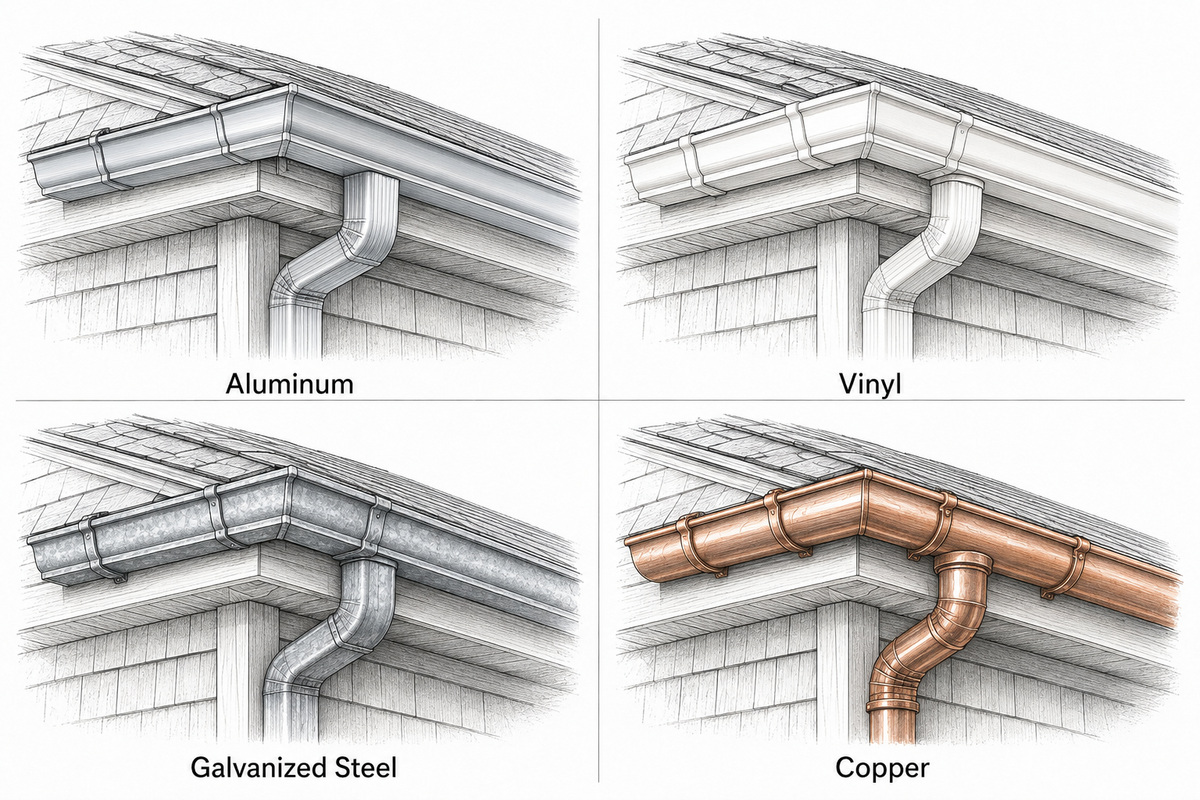
Aluminum
Aluminum is the most common residential gutter material and the right answer for most homes. It costs $6 to $12 per linear foot installed for seamless gutters, which are formed on-site from a single coil of aluminum to the exact lengths needed for each roofline section. There are no joints along the gutter runs — the most common leak point in sectional systems is eliminated entirely.
Aluminum gutters last 20 to 30 years with proper maintenance. They resist rust, are lightweight enough to not stress fascia boards, and come in a wide range of factory-baked colors that hold up far better over time than field-painted aluminum. Standard residential aluminum coil is .027 or .032 gauge. The .032 gauge is thicker and resists denting from ladder impact and falling branches better — the modest additional material cost is worth specifying.
Vinyl
Vinyl gutters are the most affordable option at $4 to $8 per linear foot installed. They are color-through, so scratches do not expose a different color, and they do not rust or corrode. The tradeoffs are durability and temperature sensitivity. Vinyl becomes brittle in cold weather and can crack from ladder impact, falling branches, or heavy snow and ice loads. Lifespan is 10 to 20 years — shorter than aluminum. Vinyl gutters are almost always sectional because there is no vinyl roll-forming process equivalent to aluminum seamless, so they have joints every 10 to 20 feet that require sealant maintenance.
Vinyl is most appropriate on budget-conscious installations in mild climates where cold-weather brittleness is not a concern. If you live where winter temperatures regularly drop below freezing, aluminum is the better choice.
Galvanized Steel
Steel gutters cost $10 to $18 per linear foot installed. They are stronger than aluminum and resist impact damage better — meaningful in areas with heavy snow and ice loads, frequent falling branches, or where gutters are regularly leaned against for roof access. The tradeoff is rust. Galvanized steel is coated with zinc to prevent corrosion, but cut edges and scratches breach the zinc coating and become rust points over time that require monitoring and touch-up treatment.
Steel gutters are heavier than aluminum, so hangers must be appropriately sized and spaced, and the fascia must be sound enough to support the additional weight. Stainless steel gutters address the rust concern at a significantly higher cost — $15 to $25 per linear foot — but are uncommon in residential applications. For most homes in snow country, .032 gauge aluminum with reinforced hanger spacing handles snow and ice loads adequately without the rust liability of galvanized steel. The comparison of aluminum seamless versus steel commercial gutters covers this tradeoff in more detail for homeowners weighing the two.
Copper
Copper gutters are the premium option in both cost and appearance. They cost $20 to $35 per linear foot installed. Copper does not rust, does not need painting, and develops a natural patina over decades — progressing from bright copper to brown to the characteristic green-blue verdigris — that many homeowners choose copper specifically to achieve.
Copper is a specialty product requiring a contractor experienced with copper soldering. The joints are soldered rather than sealed with caulk, creating permanent connections that last as long as the copper itself. Copper gutters are typically chosen for architectural authenticity on historic homes, as a design statement on high-end renovations where the appearance is part of the exterior material palette, or in coastal environments where salt air corrodes aluminum faster than inland locations.
They are not chosen for cost-driven projects. The guide to copper gutter installation walks through what a real copper installation actually involves — soldering technique, dissimilar-metal fastener rules, and the patina timeline. For homeowners weighing copper against the far more common aluminum option, the copper vs. aluminum gutters comparison covers the cost and lifespan tradeoffs directly.
The complete guide to gutter systems including types, installation, and cost covers how these materials compare across more dimensions for homeowners who want a deeper comparison before choosing.
Seamless vs. Sectional Gutters
Seamless gutters are formed on-site by a contractor using a roll-forming machine that produces continuous gutter lengths custom-fit to each section of the roofline. The absence of seams along the gutter runs eliminates the most common leak point, provides a cleaner appearance, and reduces maintenance over the life of the system. Seamless gutters are the standard for professional residential installations.
Sectional gutters come in pre-cut 10 to 20 foot lengths that are joined together with connectors and sealant. They cost less per linear foot than seamless but have joints that rely on sealant to prevent leaks. That sealant degrades over time from UV exposure and temperature cycling and requires periodic reapplication — a maintenance item that seamless gutters do not have. Sectional gutters are primarily a DIY or budget option. Most professional gutter contractors default to seamless because they own the roll-forming machine that makes seamless possible.
For most homeowners, seamless gutters are worth the additional cost. The difference in leak resistance, appearance, and reduced maintenance over the 20 to 30 year life of the system outweighs the upfront savings on sectional. The only scenario where sectional makes sense for a professional installation is when a seamless machine cannot access the site — very remote locations, some tight urban sites with no parking for the machine truck — or when a small repair section is added to an existing seamless system. The guide to seamless vs. sectional gutters covers this decision in more detail for homeowners weighing the upfront savings of sectional against seamless's long-term advantages.
How Gutters Work: The System Explained
A gutter system is more than the horizontal troughs along the roof edge. Understanding the components helps you evaluate what a contractor is proposing and why each part matters.
Gutter runs are the horizontal channels that collect water from the roof and carry it toward the downspouts. They are pitched slightly — 1/4 inch of slope per 10 feet of run — toward each downspout so water flows rather than standing. The guide to gutter slope explains why pitch matters and what happens when it is wrong.
End caps seal the ends of each gutter run so water exits only through the downspout openings, not off the ends. They are sealed with the same sealant used at miters and downspout connections — and like those connections, the sealant degrades over time and is a maintenance point on older systems.
Mitered corners join gutter runs at inside and outside corners of the roofline. These are the most technically demanding part of gutter fabrication — a poorly fitted miter leaks, and a leaking miter is often the first failure point on an aging gutter system. On seamless systems, miters are fabricated from sections of gutter material and sealed at the seams. On copper systems, miters are soldered.
Downspouts carry water vertically from the gutter to the ground. They are assembled from pre-formed sections — straight lengths, elbows, and straps that attach to the wall — to create the vertical path from gutter outlet to discharge point. The guide to gutter downspouts covers downspout sizing, placement, and drainage options in more detail.
Hidden hangers are brackets that screw into the fascia and clip over the inside lip of the gutter, holding it securely while being invisible from the ground. They should be spaced every 24 to 32 inches depending on the gutter material and gauge.
The guide to the parts of a gutter system covers each component and what to look for during a contractor walkthrough.
Gutter Guards: What They Do and Whether You Need Them
Gutter guards — also called gutter covers or leaf protection — are installed over the top of the gutter to prevent leaves, twigs, and large debris from entering the gutter channel while allowing water to flow in. They reduce the frequency of gutter cleaning but do not eliminate it entirely. Small debris like pine needles, seed pods, and roof grit can still enter through some guard designs, and the top surface of the guards themselves needs occasional brushing to clear accumulated debris that blocks water entry.
The main types of gutter guards are micro-mesh stainless steel screens, aluminum perforated covers, reverse-curve or surface-tension designs, foam inserts, and brush-style guards. Micro-mesh guards — fine stainless steel mesh in an aluminum frame — provide the best balance of debris blockage and water entry for most homes. Foam inserts are inexpensive but degrade under UV exposure within a few years and can trap moisture against the gutter bottom. Brush-style guards collect debris on top of the bristles and become a cleaning problem of their own. The full comparison of gutter guard types covers the tradeoffs between micro-mesh, reverse-curve, foam, and brush-style guards in more detail.
Gutter guards are worth the additional $3 to $8 per linear foot if trees overhang the roof and the gutters are difficult or dangerous to access for cleaning — second-story gutters on a heavily treed lot are the textbook case. If the gutters are easy to reach from the ground with an extendable wand and there are no overhanging trees, gutter guards add cost without proportional benefit. Installing guards at the same time as new gutters costs less than retrofitting them later and ensures the guards and gutters work together as a designed system.
Downspout Placement and Drainage
Downspout placement determines whether the water collected by the gutters actually gets away from the house. A gutter system that channels water efficiently to downspouts that dump it at the foundation corner has merely relocated the problem from the roof edge to the foundation.
The standard rule is one downspout for every 30 to 40 linear feet of gutter run. More downspouts distribute water across more discharge points, reducing the volume each point handles and lowering the chance of overflow during heavy rain. Each downspout should discharge at least 4 to 6 feet from the foundation via a splash block, extension, or underground drain.
Underground downspout drains carry water to a dry well, storm sewer, or daylight outlet well away from the house. They add $200 to $500 per downspout but permanently solve the "water at the foundation" problem that surface extensions only partially address. Some gutter contractors install underground drains; others refer the work to a landscape or drainage contractor. Confirm before hiring if underground drainage matters for your property. The guide to downspout extension and drainage ideas covers additional above-ground options for directing water away from the foundation.
The explanation of why gutters matter covers the relationship between gutter function, foundation protection, and basement moisture in more detail, including what happens when water is not properly managed around the foundation.
Gutter Replacement: When Repair Is No Longer Enough
Gutters do not last forever. Even well-maintained aluminum gutters eventually reach the point where repairs cannot keep up with the number of issues. Knowing when that point has arrived prevents you from spending money on repairs that would be better directed toward a new system.
Replacement makes sense when multiple seam leaks persist after resealing — the gutter material has likely degraded to the point where sealant cannot bond properly. When rust on steel gutters has penetrated through the metal. When gutters are sagging between hangers and the material has lost rigidity. When the fascia behind the gutters is rotted from years of leaking and cannot hold fasteners for new hangers. When the system is 20 or more years old and becoming a recurring maintenance burden.
Isolated issues on newer gutters — a single loose hanger, one leaking end cap, a downspout that came unstrapped — are repairable. The guide to gutter repair cost covers what these smaller, isolated fixes typically run. The key question is whether the cost of repeated repairs over the next few years approaches what new gutters would cost. If it does, replacement is the better financial decision. The guide to gutter replacement cost covers what a full replacement typically costs by material, when to bundle it with a roof job, and how to get the most value out of the project once you have decided to move forward.
What Happens on Installation Day
Gutter installation on a typical single-family home is a one-day project for an experienced crew of 2 to 3 installers. It is one of the faster and less disruptive exterior home improvement projects.
The crew arrives in the morning. If the project is a replacement, the old gutters are removed section by section and the downspouts are unstrapped from the wall. The exposed fascia is inspected for rot or damage. If minor fascia repair is needed and within the quoted scope, the crew handles it on the spot. If extensive fascia damage is discovered that was not anticipated, the contractor should communicate before proceeding with repair work.
For seamless gutters, the new gutters are formed on-site. The contractor's truck carries a roll-forming machine and aluminum coil in the selected color. Each gutter run is formed as a single continuous piece to the exact length needed, carried to the wall, and fastened in place with hidden hangers at the correct pitch toward the downspout. Downspouts are assembled from pre-formed sections — straight lengths cut to height, elbows at the top and bottom, straps that secure the downspout to the wall — and connected to the gutter outlet.
The crew tests each run with water from a hose or bucket to confirm proper pitch and drainage before cleaning up. You should walk the perimeter with the crew lead before they leave to confirm all work is complete and any concerns are addressed while the crew is still on site. This is a quick walkthrough — the system is not complex — but it is the time to identify anything that does not look right.
For gutter replacement specifically, the crew should also confirm that the old material is fully removed, the disposal is handled, and the magnet has been run to pick up any fasteners that fell during removal.
Regional Climate and Gutter Performance
Gutter requirements vary significantly by climate. The right system for a home in Florida is not the same as the right system for a home in Minnesota.
In heavy snow and ice country — the northern tier from the Dakotas through New England — gutters must withstand snow load, ice dams, and repeated freeze-thaw cycling. Aluminum gutters in .032 gauge with reinforced hidden hangers every 24 inches are the minimum specification. Gutter heaters or heat cables along the eaves can prevent ice dams that tear gutters off the fascia. Snow guards on the roof above the gutters prevent sliding snow from ripping gutters off in a single event. Galvanized steel gutters handle snow and ice loads better than aluminum because of material strength, but they introduce the rust maintenance concern.
In heavy rain regions — the Southeast, Gulf Coast, Pacific Northwest — gutter capacity is the primary concern. A standard 5-inch K-style gutter handles most rainfall on most homes, but wide roof sections or steep roofs that concentrate water at a few downspouts may need 6-inch gutters, which handle roughly 40 percent more water volume. Oversized 3x4 inch downspouts instead of the standard 2x3 inch help prevent clogs and handle high-volume flow. In hurricane-prone coastal areas, gutters should be fastened with screws rather than nails and spaced at 24 inches or closer to resist wind uplift.
In coastal salt-air environments, aluminum gutters with factory-baked finishes perform well because aluminum does not rust. Steel gutters are a poor choice — they rust even with protective coatings once the coating is breached at cut edges and scratches. Copper gutters perform excellently in salt air and are the most durable choice for coastal homes where the budget allows.
In dry climates where rain is infrequent but occasionally intense — the Southwest, parts of the Intermountain West — gutters are sometimes considered optional. However, when rain does come in these climates it is often heavy, and the dry, compacted soil cannot absorb it quickly, leading to runoff that pools at the foundation. Gutters protect against these infrequent but damaging events. Standard sizing is typically adequate because intense rainfall is short-duration.
Gutter Maintenance: What Keeps a System Working
Gutters need cleaning twice a year — once in late fall after leaves drop and once in spring. Homes with overhanging trees may need cleaning three or four times per year. Clogged gutters are the single most common cause of gutter system failure: standing water accelerates corrosion, adds weight that pulls hangers loose from the fascia, and overflows onto siding and foundation soil. The guide to gutter cleaning cost covers what professional cleaning typically runs and how often it's worth hiring out versus doing it yourself.
Beyond cleaning, inspect gutters annually for loose hangers, separated miters, leaking end caps, and downspouts that have pulled away from the wall. Most of these issues are inexpensive to fix when caught early and expensive when ignored — a leaking miter that drips onto the fascia will rot the fascia board, and replacing fascia costs more than resealing a miter.
After heavy snow or ice events, check that gutters are still securely attached — ice dams place enormous force on gutters and can pull hangers out of the fascia even when the gutters themselves survive undamaged. After major storms, check for denting from falling branches and for gutters that have shifted out of pitch. Water standing in a gutter days after rain indicates a pitch problem that is only going to get worse.
How to Choose a Gutter Contractor
Gutter installation has a lower barrier to entry than roofing or structural work, so quality varies meaningfully between contractors. Here is what to look for.
Ask whether they install seamless or sectional gutters. A contractor with a roll-forming machine for seamless gutters produces a better product than one who only installs sectional systems. The machine represents a meaningful capital investment — owning and maintaining one signals that gutter installation is a primary business line, not a side offering from a general contractor.
Ask about hanger type and spacing. Hidden hangers screwed into the fascia every 24 to 32 inches are the current standard — secure, hidden from view, and allowing for thermal expansion. Exterior spike-and-ferrule hangers are an older method that is less secure over time. If a contractor proposes spike-and-ferrule, ask why — there are few situations where it is the better choice.
Ask what gauge aluminum they use and whether they stock .032. If a contractor cannot tell you what gauge they use, they may be using the thinnest available coil to keep material costs down. The difference between .027 and .032 gauge on a whole-house project is modest — maybe $100 to $200 in material cost — and the .032 gauge resists denting and sagging meaningfully better over 20 to 30 years.
Confirm that downspouts discharge at least 4 to 6 feet from the foundation. Downspouts that dump water at the foundation corner defeat the purpose of having gutters. Extensions, splash blocks, or underground drains should direct water away from the house to a sloped area, dry well, or storm drain.
Get at least three written quotes. Gutter quotes are straightforward — linear feet of gutter, number of downspouts, material and gauge, hanger type and spacing, inclusion of guards if applicable. A quote that does not specify these items is not comparable to one that does. For replacement projects, confirm whether fascia assessment and repair is included in the quoted scope or treated as an add-on once the old gutters are down. A contractor whose quote includes fascia repair contingency is giving you a more realistic total cost than one whose lower quote leaves fascia work to be discovered mid-project.
Coordinating Gutters with Roof Replacement
If the roof is also nearing end of life, replacing gutters and roof together offers coordination advantages. The roofing contractor installs the new drip edge to accommodate the new gutters, and the gutter contractor installs to a clean fascia and roof edge with no old sealant or rust to work around. The roofing crew is already on site with ladders and safety equipment, and the gutter contractor can schedule immediately after.
However, there is no requirement to do both at once. Gutters mount to the fascia, not the roof, and a roofing crew can work around existing gutters. If the roof has 10 years of life remaining and the gutters have failed, replace the gutters now. If both are near end of life, doing them together reduces the number of contractor projects and ensures the new drip edge and new gutters are installed as a coordinated system.
Final Thoughts
Gutter installation is one of the more straightforward exterior home improvements. The cost is modest relative to the protection gutters provide — foundation repair, basement waterproofing, and siding replacement after years of uncontrolled roof runoff cost several times what a properly installed gutter system costs. Aluminum seamless gutters in .032 gauge with hidden hangers, installed by a contractor who specializes in gutter work, is the right answer for most homes. Add gutter guards if trees overhang the roof and the gutters are difficult or dangerous to access for cleaning. The system will protect your home for 20 to 30 years with nothing more than twice-yearly cleaning and occasional inspection.
When you are ready to get estimates from licensed gutter contractors in your area, Home Upgrade Pros connects you with professionals who offer free no-obligation assessments.
Gutter System Projects from Our Experts

Aug
20
How Copper Gutters Are Actually Installed
Copper Gutter Installation: A Contractor's Full WalkthroughJosh Skattum, owner of Montana Gutter Solutions in Livingston,...

Jul
15
Gutter Hanger Types Guide: The Gutter Brackets, Supports, Hangers NOT Recommended
Gutter Hanger Types: Why Plastic Hangers Always FailEverything Gutter president Jimmy DeHart Sr shows what happens when gutters...
Gutter System Ideas and Inspiration

Aug
20
Gutter Replacement Cost: What to Expect and How to Get It Right
Gutter Replacement Cost: What Homeowners Pay in 2026A dripping seam or a sagging corner is often just that — a small, isolated...

Aug
12
Which Gutter Style Is Right for Your Home: K-Style or Half-Round?
Half-Round vs K-Style Gutters: Cost & Comparison GuideK-style and half-round are the two shapes almost every residential...