


At TheRemodelers.org we don't sell anything. Instead we provide information that helps our community make decisions regarding home improvement services and projects. Click below for recommended licensed professionals that provide free no obligation quotes.
HVAC: The Complete Homeowner's Guide
 HVAC Systems: Complete Cost, Maintenance & Comparison Guide
Heating and cooling equipment is one of the most important, and most expensive, systems in a home. It affects everyday comfort, monthly utility bills, indoor humidity, air quality, and even how easily certain rooms can be remodeled or expanded. Yet HVAC terminology can make a replacement decision more confusing than it needs to be.
Most homeowners do not need every technical detail. They do need to know what the equipment costs, how it heats and cools the house, whether it needs ductwork, what it costs to run and maintain, and what compromises come with each choice.
This guide covers the five main types of heating and cooling equipment: furnaces, central air conditioners, heat pumps, ductless mini splits, and boilers. It then explains how they are combined into whole-home systems, how climate and ductwork change the best choice, and when to repair or replace.
HVAC Costs at a Glance
Typical installed prices, yearly maintenance costs, and lifespans for each system. Follow the links for full cost and maintenance guides.
System | Typical Installed Cost | Maintenance (per visit) | Typical Lifespan |
|---|---|---|---|
Furnace | 15 – 20 years | ||
Central air conditioner | 15 – 20 years | ||
Heat pump (ducted) | 10 – 15 years | ||
Ductless mini split | 15 – 20 years | ||
Boiler | 15 – 30 years |
Replacing a furnace and central AC together typically costs $6,000 to $16,000 or more, depending on efficiency. Our HVAC replacement cost guide compares whole-system options, including a heat pump that replaces both, and how to finance a new system.
What Is an HVAC System?
HVAC stands for heating, ventilation, and air conditioning. A complete HVAC system controls indoor temperature and moves conditioned air (or, in some systems, refrigerant or water) through the home. Depending on the design, it may also filter the air, manage humidity, and bring in outdoor air for ventilation.
A system generally includes equipment that creates or transfers heat, equipment that removes heat for cooling, a way to distribute conditioned air or water, and controls such as a thermostat. The parts may be split between indoor and outdoor units, combined in one cabinet, or connected to underground piping.
The Five Main Types of HVAC Equipment
 Furnace
A furnace burns gas, propane, or oil, or uses electric resistance, to heat air that a blower pushes through ductwork. It is the most common heating equipment in American homes and usually pairs with a central air conditioner that shares its blower and ducts. Efficiency is rated by AFUE.
Central Air Conditioner
A central AC cools only. An outdoor condenser and an indoor coil, usually mounted on the furnace, remove heat and humidity from the air, and the furnace blower sends the cooled air through the ducts. Efficiency is rated by SEER2.
Heat Pump
A heat pump heats and cools from one system by moving heat instead of making it. In winter it pulls heat from outdoor air into the home, and in summer it reverses. A ducted heat pump can replace both a furnace and an AC.
Cold-climate models keep heating well below freezing. Heat pumps carry two ratings: SEER2 for cooling and HSPF2 for heating.
Ductless Mini Split
A mini split is a ductless heat pump: an outdoor unit connected by refrigerant lines to one or more indoor units mounted in the rooms they serve. It suits homes without ducts, additions, and rooms that never stay comfortable, and each indoor unit can be controlled separately. Our mini split sizing guide shows what size each room needs.
Boiler
A boiler heats water (or makes steam) that circulates through radiators, baseboard heaters, or radiant floor tubing. This “hydronic” heat is common in older homes, especially in the Northeast. Boilers heat only, so homes with one often add mini splits or a separate central AC for cooling.
How the Equipment Is Combined: Five Whole-Home Configurations
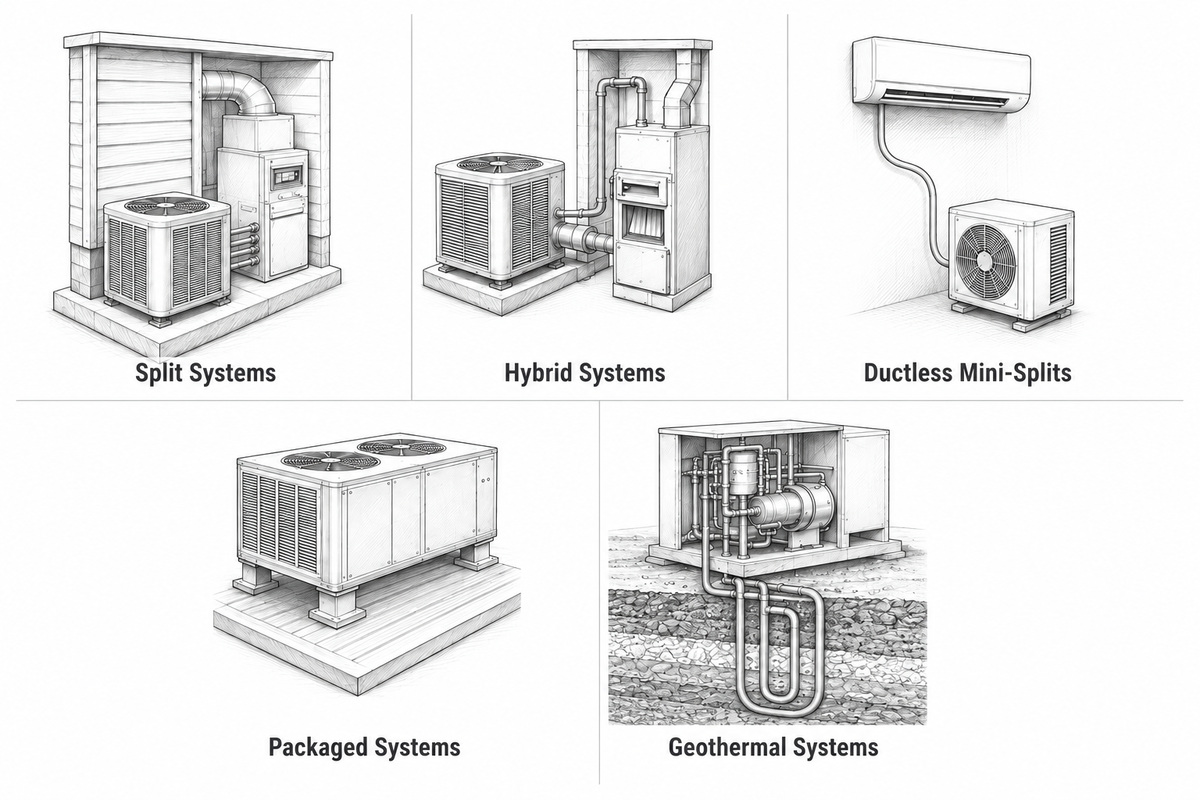
The equipment above is usually installed in one of five whole-home configurations. Within each, homeowners still choose among different capacities, efficiency ratings, compressor types, fuel sources, filtration options, and controls.
Split system: an outdoor unit plus an indoor furnace or air handler, connected to ductwork. The classic furnace-and-AC setup, or a heat pump with an air handler.
Hybrid (dual-fuel) system: a heat pump paired with a gas or propane furnace that takes over in colder weather. See our dual fuel heat pump cost guide.
Ductless mini split: one or more indoor units with no full duct system.
Packaged system: all components in one outdoor or rooftop cabinet, connected to ductwork.
Geothermal system: a ground-source heat pump that exchanges heat with underground piping. See our geothermal heat pump cost guide.
No single configuration leads in every category. The comparison below shows the broad differences homeowners should expect. Actual performance and cost depend on the specific equipment, home, climate, and installation.
HVAC System | Ductwork | Heating Source | Indoor Space Needed | Upfront Cost Tendency | Zoning Potential | Best General Fit |
|---|---|---|---|---|---|---|
Split system | Usually required | Furnace, electric heat, or heat pump | Moderate | Moderate | Moderate with added controls | Homes with existing ducts |
Hybrid system | Usually required | Heat pump plus gas or propane furnace | Moderate | Moderate to high | Moderate with added controls | Mixed or colder climates with dual-fuel value |
Ductless mini-split | No full duct system | Electric heat pump | Small, but indoor heads are visible | Low for one zone; higher for many zones | High | Ductless homes, additions, and targeted zones |
Packaged system | Required | Heat pump, electric heat, gas, or dual fuel | Very little indoors | Moderate | Usually limited without added controls | Homes designed for rooftop or outdoor packaged equipment |
Geothermal system | Often used, though hydronic options exist | Ground-source heat pump | Moderate | Highest | Moderate to high, depending on design | Long-term owners with suitable property conditions |
Which Configuration Is Most Energy Efficient?
Geothermal systems generally offer the highest operating efficiency because they exchange heat with stable ground temperatures. But “most efficient” does not automatically mean “best financial choice.” Installation can cost much more, and the value of the savings depends on how long you keep the home and what geothermal replaces.
Ductless mini splits can also be highly efficient, particularly when they replace electric resistance heat or let you condition only occupied zones. A well-chosen central air-source heat pump can deliver similar advantages through ductwork.
Hybrid systems aim to use the cheaper energy source at any given time. Their advantage depends heavily on the changeover strategy and on local electricity and fuel prices.
Split and packaged systems cover a wide efficiency range, and the configuration alone does not determine it. Equipment ratings, compressor technology, duct condition, sizing, climate, controls, and installation quality can matter as much as the system type.
Which Configuration Costs the Least to Install?
The least expensive option is often the one that works with the home’s existing infrastructure. Replacing a split system with a compatible split system is usually cheaper than redesigning the distribution system, and replacing a packaged unit with a matched packaged unit may avoid structural changes.
A single-zone mini split can be one of the least expensive ways to heat and cool one addition or problem room. It should not be compared directly with a whole-home system, though, because conditioning an entire house with several indoor units changes the math.
Geothermal normally has the highest upfront cost because of drilling or excavation and the ground loop. A hybrid system typically costs more than a basic furnace-and-AC split system because it combines heat pump and furnace equipment.
Compare complete installed proposals, not just equipment prices. Electrical upgrades, duct repairs, permits, equipment pads, roof work, condensate drainage, fuel connections, controls, and removal of old equipment can change the total significantly.
How Climate Changes the Best Choice
Climate affects both equipment capacity and operating strategy. In hot, humid regions, cooling performance and moisture removal may dominate the decision. Variable-capacity equipment can improve comfort by running longer at lower output, but only when the system is sized and configured correctly.
In mixed climates, an air-source heat pump or hybrid system can provide efficient heating through much of the year, and a hybrid adds fuel-fired backup for colder periods. Cold-climate heat pumps have expanded the range of homes that can use electric heat, but compare published low-temperature capacity, not just the nominal size on the model.
Geothermal systems are less affected by outdoor temperature swings, though the ground loop must still be designed for the home’s heating and cooling loads. Packaged systems work in many climates, but their outdoor exposure and heating configuration deserve particular attention.
Ductwork May Decide the Question
Existing ductwork is one of the biggest dividing lines among HVAC options. If a home has no ducts, adding them can require soffits, chases, attic work, crawlspace access, or opening finished surfaces. In that situation, ductless mini splits may be far less disruptive.
If good ductwork already reaches every important room, a split, hybrid, packaged, or ducted geothermal system can use that investment. But ducts should be evaluated, not assumed adequate. Leaks, poor insulation, undersized returns, crushed flexible ducts, and bad room balance can make new equipment perform like an old system.
Before buying a high-efficiency unit, ask whether the contractor has inspected the whole air-distribution system. Repairing ducts and correcting airflow can sometimes improve comfort more than moving up one efficiency tier.
Comfort, Zoning, and Appearance
Ductless mini splits give the most direct room-by-room control because each indoor unit serves a defined area. That can end thermostat arguments and avoid conditioning unused spaces. The tradeoff is visible indoor equipment and filters to clean at each head.
Central systems deliver a more uniform, unobtrusive look through registers and grilles. Zoning can be added to some ducted systems with motorized dampers and compatible controls, but the ducts and equipment must handle changing airflow. Simply closing registers is not a safe substitute for engineered zoning.
Variable-speed and variable-capacity systems may run more quietly and hold steadier temperatures than basic single-stage equipment. These features exist across several system types, so compare specific models rather than assuming one type always provides better comfort.
Questions to Ask Before Choosing an HVAC System
Before signing a contract, ask the contractor to explain the recommendation in terms of your house, not just the equipment brand.
Was a room-by-room load calculation completed? Replacing equipment based only on the old unit’s size can repeat an earlier sizing mistake.
What condition is the ductwork in? Ask about leakage, insulation, return-air capacity, airflow, and room balance.
How will the system perform at local design temperatures? Heat pump buyers should review low-temperature heating capacity and backup-heat strategy.
What are the estimated annual operating costs? The estimate should use local utility rates and realistic assumptions.
What work is included? Confirm permits, electrical changes, fuel work, drainage, thermostats, duct changes, equipment removal, commissioning, and cleanup.
How will proper installation be verified? Ask about airflow measurement, refrigerant charging, combustion safety where it applies, and startup documentation.
What maintenance will the system need? Compare filter access, number of indoor units, outdoor or rooftop access, and specialized service needs. The maintenance guides linked in the cost table above explain what a real visit involves for each system.
Which incentives apply to this exact model and installation? The federal 25C credit ended for equipment installed after December 31, 2025, but some state and utility programs remain, and eligibility can depend on efficiency ratings, location, and installation date.
When Something Breaks: Repair or Replace
Eventually, even a well-maintained system needs a repair, and at some point repeated repairs stop making financial sense. A few signals apply to every system: age past the 12-to-20-year range typical for most equipment, a repair cost that approaches a meaningful fraction of replacement cost, and any safety-related failure, such as a cracked heat exchanger, a refrigerant leak, or a combustion problem.
Correct diagnosis matters more than homeowners often expect. A system that won’t turn on, won’t reach temperature, or cycles unpredictably can point to several different parts depending on the system. A technician who identifies the specific failed part, rather than replacing parts one at a time, keeps you from paying for repairs that were never the problem.
Each repair guide covers the common failures, real costs, and repair-versus-replace signals for its system:
Final Decision: Which HVAC System Is Right for Your Home?
For many homes with existing ducts, a split system remains the straightforward, widely serviceable choice. A hybrid system is worth considering if you want heat pump efficiency in mild weather and fuel-fired heat in the cold. A ductless mini split is often the cleanest solution for a home without ducts, a new addition, or rooms that need independent control.
A packaged system can be the practical answer when indoor mechanical space is scarce or the house was built around rooftop or outdoor equipment. A geothermal system offers exceptional efficiency and stable operation, but it needs a suitable property, specialized design, and a much larger initial investment. Homes with radiators or baseboard heat usually do best staying with a boiler and adding ductless cooling if needed.
The best HVAC system is not simply the one with the highest efficiency number. It is the one that fits the home, is correctly sized, uses a sensible energy source, distributes heating and cooling well, and can be maintained by qualified professionals. Compare at least two detailed proposals, and ask each contractor to explain how the recommendation fits your house, not just how it replaces the old equipment.
Comparing real proposals is the fastest way to narrow the choice. Home Services Pros connects homeowners with licensed HVAC contractors in their area for free, no-obligation estimates, or call (833) 586-2038.
Sources and Further Reading
U.S. Department of Energy, Energy Saver: central air conditioning, heat pump, and geothermal heat pump guidance
ENERGY STAR: ductless heating and cooling and air-source heat pump guidance
Frequently Asked Questions
How much does a new HVAC system cost?
A single system typically costs $2,000 to $15,000 installed, depending on type. Replacing a furnace and central AC together usually runs $6,000 to $16,000 or more, and a ducted heat pump that replaces both runs $4,000 to $15,000 or more.
How do I choose a heating and air conditioning system?
Start with what the home already has. Existing ductwork favors a split, hybrid, or ducted heat pump system, a home without ducts favors mini splits, and a home with radiators usually keeps its boiler. Then weigh your climate, energy prices, and how long you plan to stay, and insist on a room-by-room load calculation.
What is the best type of HVAC system?
No single type is best for every home. Geothermal is usually the most efficient but costs the most to install. A ducted heat pump or a furnace-and-AC split system suits most homes with good ductwork, and mini splits are often best for homes without ducts.
What is the best HVAC system for new construction?
New construction lets you design the ductwork and the system together, so a correctly sized ducted heat pump or split system is a common choice. Very efficient homes sometimes need so little capacity that ductless mini splits work well. A room-by-room load calculation should drive the decision.
How long do HVAC systems last?
Furnaces and central air conditioners typically last 15 to 20 years, heat pumps 10 to 15 years, mini splits 15 to 20 years, and boilers 15 to 30 years. Yearly maintenance helps equipment reach the upper end of those ranges.